Never Look Back & Death and the Oxford Box

Never Look Back is the first in a police procedural series featuring DI Lockyer and his team.  In this case, a serial killer targeting young women is the focus of DI Lockyer investigation.   DI Lockyer is also very much the focus of the novel in the sense that he is a fully fleshed out character and the reader feels his emotions and the conflicts he experiences.  He is a very “normal” man, not an alcoholic or a hopelessly damaged individual, just someone trying to his best to do his job and be there for his family.

The mystery is well done and intriguing with red herrings to keep you guessing.  The ending connects the cases and the characters up neatly.  The book was fast paced and kept me turning the pages.  I finished it in one sitting.  I will definitely read more in this series.

I came across Death and the Oxford Box by a somewhat circuitous route.  I was at the library book sale and found 3 books with Oxford in the title with references to Morse on the back cover so I threw them in by bag.  When I got home and researched them, I found they were books 5, 7, and 9 in a pretty long running series, which I had not heard of before.  Death and the Oxford Box is book 1 in this series and I checked it out of the library.   This is not a police procedural like Morse. However, it is set in Oxford.  The protagonist, Kate Ivory, is a novelist, who belongs to a running club.  Another member of the club is going through a somewhat nasty divorce in which the ownership of some enamel boxes, including the Oxford box, is in dispute.  Kate, the spurned wife, and the other members of the club develop a plan to steal the boxes and hide them.  At this point, I really began to wonder about the protagonist’s IQ.  The running club’s simple little theft is complicated by a murder and then Kate investigates to clear all their names.

I had a number of issues with this novel.  First, Kate Ivory, is supposedly an educated woman, a novelist, and upon hearing that a friend is having difficult issues with a divorce, doesn’t suggest getting a good lawyer.  No, instead she says:   “Let’s make a copy of his girlfriend’s apartment keys, enter her home when they are not there, take the items you say are yours, hide them, and then lie to the police about all of our whereabouts when it turns out that someone used our little plan to commit a murder.”

I cannot fathom anyone thinking this is a good idea.

I also did not get a good sense of place from the novel.  It was under 200 pages so perhaps there was not time to really develop much, but I would have liked to definitely get more of a sense of being in Oxford.  This could have been in Oxford, Mississippi except for some of the language.

All that being said, this series continues for about 15 books, so either I am completely off-base or it gets better as it goes along.  I will probably try at least one more in the series.

Himself by Jess Kidd

33023729

Himself is a magical realism novel with dark fairy tale and comic elements interwoven.  The book centers around Mahoney, an orphan who returns to Mulderrig, after receiving a letter telling him that it is the town of his birth.  His arrival stirs up the town, terrifying, angering and exciting the various residents depending upon their involvement in his arrival at the orphanage.

The magical elements are  spellbinding and  atmospheric.  The sense of isolation and other worldliness of the village and in its inhabitants comes through the pages clearly.  The murder mystery is cleverly done and the cast of characters provide ample possible suspects and motives to sift through.

An interesting take on a murder mystery with a magical realism twist.  Very enjoyable read!

The Children of Men & Sycamore

The Children of Men is a dystopian by PD James, who usually wrote mystery fiction.  This is definitely not a YA type of post-apocalyptic dystopian.  There is more of a quietness here.  This is a society winding down, at the end of its days.  Not going out with a bang, but more of a whimper.

The premise is that humans have stopped reproducing.  The last generation to be born was about 25 years ago.  Xan is the so-called, Warden of England, in reality an absolute ruler with his council.  The story is often told by Theo, Xan’s cousin, in flashbacks to his youth and diary entries.  Theo is approached by a group that rejects the rule of Xan and wants to reinstitute democracy, although their own agenda is rather muddled even among themselves.

The novel includes many christian references and themes starting with the title itself being lifted directly from the psalm,  “Thou turnest man to destruction; and sayest, Return, ye children of men.”  Julian represents the Virgin Mary and a miracle birth.  Theo’s name is the Greek word for god.  The symbolism of water and baptism used throughout.  The character of Luke, both his name and the fact he is a priest.  The use of churches as meeting places and the name of the group as the five fishes are all part of openly pointing to the book as a Catholic allegory.

Beyond religion as a theme, there is the conflict between religion and science.  The idea is laid out in the beginning that science has failed to halt the death of man.  That scientists around the world have been unable to find an answer and continue to search to no avail.  PD James clearly wanted the message to be that somethings are beyond man’s control.

The other major theme explored here is the corruption of power or “absolute power corrupts absolutely”.   Xan and his council began at the will of the people and with each new dictate gained more power and became more and more oppressive.  There is also an idea of people being complicit in their own oppression.  Willingly trading freedoms, for comfort and pleasure.

I am not religious at all, but I enjoyed this book greatly.  I find it difficult to explain this dichotomy other than to say that PD James managed to  write  an obviously pro-faith book in a way that was not preachy and did not feel like a sermon at all.

I don’t really remember why I checked Sycamore out of the library.  I must have had a recommendation from somewhere.  This would be considered a mystery.  The novel follows two time lines, past and present.  In the past, Maud and her teen daughter, Jess, moved to Sycamore, a small town, and lived there until Jess inexplicably disappeared after some small town scandal.  In the present Laura, who just moved to town to recover from her divorce and make a new start, literally stumbles upon Jess’s remains.

There are quite a few characters that you meet in the past and in the present chapters both.  The main idea here is to explore how one person’s disappearance impacted multiple people in this small town for years.  It is as though they were in a state of stasis, waiting, even though they weren’t sure for what.  Then, Jess’s body is discovered and everyone wakes up and finally begins to move on.

The major themes explored here are grief, loss and regret.  All these were tied up with the death of Jess and the events immediately prior to it.  Also, I would suppose secrets, since many people didn’t reveal things they knew about the night of her disappearance.

There are some good ideas here and some good parts to this novel.  The characters of Jess, Maud and Roberto in particular are interesting and draw you into their stories.  Others characters just didn’t have enough time devoted to them in order to develop their stories.  I don’t know if the solution was to have fewer characters and develop them more fully or make the book longer.  I did really enjoy Jess’s story and finding out what happened to her.


Americanah by Chimamanda Ngozi Adichie

15796700

I had been meaning to read this book for a while and finally got to it.  The beginning sucked me in immediately with the setting.  The sense of place, Princeton and Trenton, New Jersey rang so true and was very firmly established, completely engaged me in the beginning.  I found the author’s commentary on race as an outsider looking in at the US insightful and more importantly true to the character’s voice.  At times, when an author tries to write a book about social or political issues the character’s voice gets lost and it is just the author speaking, but that does not happen here.  It truly feels as though it is Ifemelu who is speaking.

Although there are ostensibly two main characters, Ifemelu  and Obinze, it really feels as though Obinze is an afterthought.  He exists only in how he reacts and interacts with Ifemelu and how she ultimately impacts his life.   Most of the rest of the large cast of characters are only momentarily in the book, Ifemelu interacts with them, usually unpleasantly, and then reacts or moves on and then there are other characters for her to deal with in some manner.

I really wanted to like this book, especially with the promising beginning, however, there were just too many things that I could not completely ignore.  It felt too long, about 150 pages or so too long.  It could have done with some serious editing.  It is a novel about two lovers, not an essay on race relations and unfortunately I would not wish Ifemelu on my worst enemy.  She is judgemental, immature, self-righteous, a liar, a cheater, and a snob.  She was for me completely unlikable and incapable of love.  Although there are novels in which that is not an issue, it is a problem when she needs to carry an almost 500 page “love” story.

The turns of phrase, the insightful discussion of racism, (although I could have done with more showing and much less telling, hence my editing remark), the commentary about Nigeria, the development of sense of place, and the introduction of interesting and sympathetic characters (who unfortunately are whisked away quickly) all are so incredibly well done that I will definitely read more by this author.

The Ocean at the End of the Lane by Neil Gaiman

15783514

I am on the waiting list for American Gods at my library so in the meantime I picked this up.  I wasn’t sure what to expect but this was a fantastical read, along the line of magical realism.  The story begins with a man returning to his childhood home for  a funeral.  He finds himself driving to the home of a childhood friend who has emigrated to Australia, as far as he knows.  Once he arrives at her home and walks along the path to the “ocean”,  his memories return of the events of his childhood, both the fantastical and the horrifying.  ‘

The book explores the major theme of memory and how memory shapes us and impacts our life.  Also, how memories are made and kept.  Other themes include fear, represented by both Ursula and the hunger birds.  Loneliness and isolation shown by the birthday party and the location of the home.  The kittens represent the innocence of childhood and the innocence lost to the narrator through the events of the book.  Wisdom and time are also explored within a supernatural and multi-dimensional context.

Magical realism/fantasy is not my usual genre but I did enjoy this and it has definitely piqued my interest in American Gods.

Cat’s Eye by Margaret Atwood

51019

Cat’s Eye is the story of a painter, Elaine, who is returning to the city of her childhood and adolescence for a retrospective of her work.  The return sparks vivid reminiscences of a past that includes three girls who in turns bullied and befriended Elaine when she was a confused, lonely,  and socially inept 8-year-old.  Cordelia was the ringleader of the bunch.  The story is told in past and present as Elaine relives what happened and what is currently occurring and comes to the realization that the events of her past have left a lasting impact on her as a woman, a mother, a wife, and an artist.

The main theme this book explores is relationships, Elaine’s relationship with her family, with her brother Stephen, with the three girls and with Cordelia in particular, with God, with her artistic mentor, with both of her husbands, and finally with  her daughters.  Elaine is one of the “others”, an outsider.  Her early childhood and her unconventional parents left her uncertain when navigating stereotypical female roles and social cues.  Even into her 50’s, as she looks back on her life, Elaine still is haunted by the events of her childhood.

An excellent read, my favorite Margaret Atwood book so far.

The Missing One by Lucy Atkins

21432586  This was a total impulse read.  I saw it on the shelf at the library next to Kate Atkinson books I was looking at and grabbed it.  I am also a sucker for the dark family secret type plots so this was right up my alley.

Kali, is the mother of young child, whose own mother, Elena, has just died and who suspects her husband is cheating on her with an attractive ex.  Devastated by the betrayal by her husband and the loss of her mother, who she had been distant from her whole life, Kali decides to follow up on some clues from her mother’s house to try to learn about Elena’s life.  Kali flies to Canada on this quest to find out who her mother really was and why she never connected to Kali or Kali’s young son in any meaningful way.

The book has a nicely paced beginning and end, but could have used a touch of editing in the middle to trim it down as it began to drag a little there.  Kali as a character seems fully fleshed out, but a little slow to sense the instability that Susannah is pretty clearly exhibiting.  Susannah and Elena are really interesting characters as told in the current time line, through journal entries and letters, and in memories.  Elena, in particular, with her fatal flaws and the tragic consequences is so well done.  The resolution felt authentic and worked with the characters and the story.

Enjoyable quick read about the secrets family’s keep and the consequences of exposing them to the light.


Harvest Home is an excellent example of folk horror along the lines of The Wicker Man set in America rather than England.  The protagonist, Ned, has taken his family to live in the country where he plans to pursue his new career as a painter.  The family is accepted into the rather insular New England Community, particularly  after an accident in which their daughter is saved by a local healer woman rather than modern medicine.  Ned begins to question whether everything is really as peaceful as the bucolic setting would seem to indicate.

The plot is engaging and well paced. It is easy to feel Ned’s building sense of unease at his family’s new home and neighbors.  Each piece of “evidence” or secret that Ned uncovers adds to the tension and the feelings of dread. The sense of place is well established and add to the build up of tension due to the isolation.  Ned finds the answers he has been seeking and pays a horrible price.

Highly recommended for fans of folk horror!

I have been seeing multiple recommendations on Reddit and other places for Red Rising and decided to try it even though I am not a big Science Fiction reader.  The story’s premise is based around the colonization of Mars and the society established there to achieve this end.  People are divided into groups assigned colors Red, Silver, Gold, etc.  Darrow, the protagonist is a Red, he works underground and at the beginning of the book believes he is working for the future good of his people, so that someday the colony will be established on the surface with terra forming and the like.  He works the dirty, dangerous job of mining to feed himself and his beautiful wife Eo.

It is quickly revealed the whole thing is a scam, the surface has been inhabited for centuries by the higher colors and the lower reds, such as Darrow are basically slaves.  Darrow is selected by a revolutionary group to be  modified via surgeries and chemicals to pass as gold and infiltrate their society via an elite training school.

The plot felt to me like a merging of  Riddick (the mining/underground scenes), Total Recall (bad guys keeping the poor of Mars down), Divergent (groups sorted by narrowly specified categories into duties, tests to belong to a specific group), and Hunger Games (school environment, survival of the fittest).  There was really not anything here that I haven’t seen before and I don’t read much science fiction.

If the character of Darrow was female, he would definitely be a Mary Sue.  He is just the best at everything and given his early life as an uneducated slave raised to work in a mine, it was really unrealistic.  The treatment of women in this book is just abysmal.  Eo is only there to sacrifice herself to move Darrow’s story forward.  She is a prop with no worth at all as a person. Most of the  other females are there to be raped or assaulted without consequence, not really progressive at all.

Perhaps it is just that I am not the target demographic, but I don’t really see this as worthy of all the attention and recommendations that it receives.  It just seems to have taken ideas from popular science fiction movies/books and merged them into something that will be very marketable as a screenplay.


The Last Days of Ptolemy Grey, The Crow Trap, & Long Lankin

I have had an excellent couple of reading days with these three books.  I enjoyed all three of them!

Long Lankin is a book I found searching for more British Folk Horror.  I am a fan of that small sub-genre of horror and this book was no exception.  The scene is a typical isolated, rather dilapidated, manor house with an unsavoury past.  Two young girls are sent by their father to stay with their aunt, who has secrets and sorrows of her own.  The tension builds as pieces of the family’s and the Long Lankin’s history are revealed.  Creepy and enthralling, I read this through in one sitting.

The Crow Trap is the first book in the Vera Stanhope Series.  I love the TV series based on the books and I can’t really say which is better the books or the show.  They are both excellent.  The Crow Trap begins with a suicide at an isolated farm.  It seems like a case of an overwhelmed carer  who has just snapped.  The book involves a team of scientists doing environmental research on the local area prior to it being quarried.  One of the scientists dies and Vera, along with Joe, are called in to investigate.

This was a great mystery.  It had such a strong sense of place.  The characters were all fully fleshed out.  The scientists and their supervisor were all individuals and not just stereotypes with quite a bit of background given for them.   Vera herself is a unique character in detective fiction. Brash, unfeminine,  seeming at times to lack social skills, appearing messy and disorganized and yet able to connect the dots to solve her cases.  Vera can be a study in contradictions and much of this comes from her upbringing and that is hinted at in this novel.  The mystery itself was well paced, there was an overall sense of tension at points and I found it hard to put the book down.  5 out of 5 stars for me.

The Last Days of Ptolomy Grey follows the last few months in the life of Ptolemy Grey.  When the book opens, he is 91 and suffering dementia to the point he is living in a roach and vermin infested apartment, sleeping under a table, and with the bathroom being broken for years.  The death of his primary carer, Reggie, facilitates a change in his life. Reggie dies in a drive by shooting and at his funeral Ptolemy meets Robyn, a beautiful young woman.

Robyn becomes Ptolemy’s muse and new carer.  He meets a “doctor” who offers him a deal, 3 months of lucidity but then death or  years more of life in the haze of dementia.  Ptolemy decides on lucidity knowing that it is for  a brief period, just enough to allow him to do things he needs to do.

Ptolemy is an enduring character and even as he was dementia addled, a rich and vibrant storyteller.  Ptolemy and his relationship with Robyn are what make this a really good read.


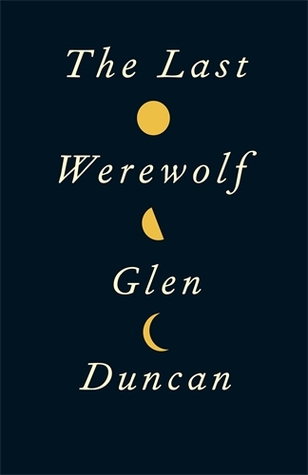
The Last Werewolf by Glen Duncan

9532302  I was engrossed in this book from the first page.  Jake, a 200-year-old werewolf, finds himself now the last of his kind, so the Grand Prize of sorts for the hunters of his kind.  Jake is pretty much tired of living anyway and ready to put things in order and sign off.

Unfortunately, things don’t go necessarily to plan.  Between vampires with agendas, a demented and entitled  heiress, infighting  hunters, scientists, prostitutes, and Jake’s familiar, Harley, there is just way too much that can go wrong and it pretty much all does.   The werewolf here is a singularly driven creature with a mantra, if you will, of primal urges, summed up insistently by Fuckkilleat!  Neither the werewolf nor the man make any apologies for the lives taken under the pull of the moon.  What would be the point of apologizing for one’s nature?

I found the book beautifully written, thought provoking, and engaging.  It just flowed and I finished it in the space of an afternoon.  It does contain copious amounts of graphic sex and violence and I have read reviews that have indicated that this turned some readers off so be aware of this ahead of time.  This is no sparkly werewolf love story novel, instead it is a great take on a  werewolf  lore and a great book.